
I never thought I'd be able to appreciate a man-pama (perm) until I met Goo Junpyo.
Let's cue the cheesy music and enjoy...
Thursday, April 30, 2009
Tuesday, March 17, 2009
Chapagetti (짜파게티)!

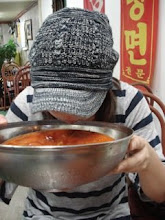
There are moments when I enjoy a bag of Chapagetti or Chacharoni over "real" jajangmyeon...


Mmmh.
Friday, March 13, 2009
Goshitel
Goshitel's a pretty fun word to pronounce in a bad American accent. So what is a goshitel? Simply put, a goshitel is a cozy little closet that some people call "home" and others call "storage space." More nicely and appropriately put, it's an inexpensive living alternative similar to a dorm, usually for university students looking to get their study on.
I can't speak for goshitels or goshiwons in general, but from my personal experience (see video above), it was really clean and well-kept, always well-stocked with free rice, eggs, kimchi, and ramen, and aside from the occasional slamming door, very quiet. I definitely didn't get that homey community feel I got from my hasuk-jip, but I did run into a couple nice people in the kitchen-dining-laundry room from time to time. And you know what? It was kind of neat being able to reach everything I needed within comfortable arms' length. :)
The reason I moved into one for a few months last summer was simple - I wanted air conditioning! My friend scared me into believing the horrors of living AC-less in Korea (dying of heat and being bitten alive by mosquitoes), and I decided straightaway that I wouldn't be able to handle anything remotely close to that. We went searching for an AC-ed hasuk, but none of them met my cleanliness standards given the short turn around time. I was slightly worried that I'd develop claustrophobia, but surprisingly, I rarely felt that way, maybe because I broke up weekends by crashing at relatives' and tended to not stay in the room for long periods at a time. :)
P.S. In case you're curious, here's the "well-being tel" I bunked up in: http://www.id.wbtel.net/ My room went for about 350,000 won, but it was window-less (yeah, I don't recommend that), while some of the ones with bathrooms in the unit were as high as five or six hundred thousand. On a side note, when one of my friends came to visit, she stayed in a room with a bathroom, and unfortunately, the ventilation wasn't so great, which kind of gave the room an interesting funk. On another note, goshitels are also great low-cost alternatives to hotels, especially if you don't plan on staying inside much - her room cost about $100 for a week!
I can't speak for goshitels or goshiwons in general, but from my personal experience (see video above), it was really clean and well-kept, always well-stocked with free rice, eggs, kimchi, and ramen, and aside from the occasional slamming door, very quiet. I definitely didn't get that homey community feel I got from my hasuk-jip, but I did run into a couple nice people in the kitchen-dining-laundry room from time to time. And you know what? It was kind of neat being able to reach everything I needed within comfortable arms' length. :)
The reason I moved into one for a few months last summer was simple - I wanted air conditioning! My friend scared me into believing the horrors of living AC-less in Korea (dying of heat and being bitten alive by mosquitoes), and I decided straightaway that I wouldn't be able to handle anything remotely close to that. We went searching for an AC-ed hasuk, but none of them met my cleanliness standards given the short turn around time. I was slightly worried that I'd develop claustrophobia, but surprisingly, I rarely felt that way, maybe because I broke up weekends by crashing at relatives' and tended to not stay in the room for long periods at a time. :)
P.S. In case you're curious, here's the "well-being tel" I bunked up in: http://www.id.wbtel.net/ My room went for about 350,000 won, but it was window-less (yeah, I don't recommend that), while some of the ones with bathrooms in the unit were as high as five or six hundred thousand. On a side note, when one of my friends came to visit, she stayed in a room with a bathroom, and unfortunately, the ventilation wasn't so great, which kind of gave the room an interesting funk. On another note, goshitels are also great low-cost alternatives to hotels, especially if you don't plan on staying inside much - her room cost about $100 for a week!
Tuesday, March 10, 2009
Lotteria's Rice Bulgogi Burger!


I don't eat beef burgers, but MC does, and last year, he gave Lotteria's rice bulgogi burger a generous 5/10 rating. I managed to take a bite of the rice "bun," and you know what, it wasn't half bad. I bet this thing would sell pretty well in Hawaii, home of McDonald's Portuguese sausage, eggs, and rice breakfast!
PS. Is it just me or does the burger wrapper seem a little... inappropriately amusing?
Saturday, March 07, 2009
Eating at Sanchon in Insadong
I'm not much of a meat eater so I may be a bit biased, but this is definitely a place you should try at least once - its extravagant spread of vegetarian temple food, clean flavors, and decor warrant a visit - and it's a particularly good experience for out-of-towners.


Review: http://www.seoulstyle.com/seoul-sanchon.htm
Website: http://www.sanchon.com/
Dragon beard candy in Insadong (인사동 꿀타래)

Mmh, nothing like 16,000 strands of stretched out sugar wrapped over nuts to satiate your sweet tooth!

You can find these 꿀타래, or dragon's beard candy, stands in touristy areas like Insadong and Myeongdong; they can draw quite a crowd with their enthusiastic cries of candy making joy in just about any language you please. (Well, for the record, I've only heard it in Korean, English, Japanese, and Chinese.) Is that really 16,000 strands, you say?!
Who doesn't love dak kalbi (닭갈비)?
Every single American friend I've introduced dak kalbi (닭갈비) to has taken quite the liking to it. How could you not? Watch Stephanie as she becomes mesmerized with the yum-yum-in-the-tum-tum stir fry. I think I'm going to open up my own place stateside. Would you come visit?
Gyeongbokgung (경복궁)
We were going to put together a silly "Seoul guide" video but never got around to filming the rest... maybe next time. ^^ I thought I'd share this clip anyway.
Thursday, March 05, 2009
Street food


There's nothing like deep fried goodness and rice cakes soaked in chili pepper paste, especially when you're in need of a quick bite or cheap eats (particularly nice after a few too many drinks). I can't say I'm 100% confident that it's completely sanitary, but it sure is tasty. ^^
Those darn acronyms

I've had more than my fair share of Korean slip-ups. I found this English one amusing. ^^ These are the types of things you'll never forget, and it's definitely beneficial to the learning process.

Speaking of which, I've started a blog in Korean, mainly to practice my writing. I've yet to update it, but the URLs can be found at cheripracticeskorean.blogspot.com and blog.naver.com/csaito. ^^
Saturday, February 21, 2009
You can take the girl out of Korea...
...but she'll make the kitchen smell like kimchi. ^-^
Some random home cookin', granted, it doesn't look very appetizing so you'll just have to take my word for it. I wish you could have seen my delicious japchae, hehe, I was damn proud of that beautiful thing.


And just for kicks, my œuf mimosa (because it sounds so much cooler in French.)

Some random home cookin', granted, it doesn't look very appetizing so you'll just have to take my word for it. I wish you could have seen my delicious japchae, hehe, I was damn proud of that beautiful thing.


And just for kicks, my œuf mimosa (because it sounds so much cooler in French.)

How to eat your chamchi Korean style
Now there are two things in the world I love, one of which is sesame oil. It's savory scent is almost as good as, if not better than, inhaling gasoline. I admit the latter's an acquired taste. But honestly, I'll put sesame oil in just about anything - in my salad dressing, on my rice, in my noodles, while I'm frying up an egg, doong doong. (On a side note, I'm considering replacing all future 'etcetera's with the much cuter sounding Korean version, 등등 doong doong. "Hobbies? I like writing, playing tennis, dining out, doong doong. Favorite food? Ice cream, roasted hazelnuts, cheese, doong doong.") The other is fresh ahi, what I'm accustomed to calling "tuna" in Hawaii, or "chamchi" in Korean.
I went to another "chamchi jib," a restaurant specializing in tuna, a while back in Suwon. This one charged a minimum 65,000 won a head, which meant we were treated to sprinkles of fancy gold flakes over our sashimi. The entire spread easily included over a dozen additional non-tuna courses, ranging from a simple salad to fresh shrimp, and by fresh I mean alive and kickin' - one of them literally jumped off the plate.

One of the most interesting things I discovered upon this visit was the fact that the tuna platter was served with not only salted kim (also known as nori, or dried seaweed), but also three types of dippings - hot sauce, soy sauce, and sesame oil. Having eaten poke all my life, I don't know why I found this so marveling. Sesame oil and tuna, you say? No... really? Yes, really. I had noticed Koreans eating it this way before, but I guess old habit or pangs of hunger had overruled curiosity as I ignored the practice and went along with my usual face-feeding ways, sans nori and sesame oil. Still, I thought it was worth sharing - how to eat your chamchi Korean style: dip, add, wrap, and repeat. : )


I went to another "chamchi jib," a restaurant specializing in tuna, a while back in Suwon. This one charged a minimum 65,000 won a head, which meant we were treated to sprinkles of fancy gold flakes over our sashimi. The entire spread easily included over a dozen additional non-tuna courses, ranging from a simple salad to fresh shrimp, and by fresh I mean alive and kickin' - one of them literally jumped off the plate.

One of the most interesting things I discovered upon this visit was the fact that the tuna platter was served with not only salted kim (also known as nori, or dried seaweed), but also three types of dippings - hot sauce, soy sauce, and sesame oil. Having eaten poke all my life, I don't know why I found this so marveling. Sesame oil and tuna, you say? No... really? Yes, really. I had noticed Koreans eating it this way before, but I guess old habit or pangs of hunger had overruled curiosity as I ignored the practice and went along with my usual face-feeding ways, sans nori and sesame oil. Still, I thought it was worth sharing - how to eat your chamchi Korean style: dip, add, wrap, and repeat. : )


Wednesday, February 11, 2009
Gee Gee Gee!
When I heard this song (SNSD's "Gee") for the first time, all I could do was cringe... I have to admit though, it's since grown on me, and dare I say that I've actually come to enjoy it? o_O haha, in certain doses of course. Anyway, this remix version was pretty cool...!
Original:
Original:
Saturday, January 24, 2009
I want nobody but YOU
One of my favorite YouTubers, singindork888, did a nice cover of the Wondergirls' Nobody... ^^
Friday, January 09, 2009
K-drama, a guilty pleasure
Since I can't sleep, I've been finding other ways to keep myself distracted... and this is the latest, 꽃보다 남자, a fantasy K-drama with I'm sure will be yet another fun rags to riches storyline, apparently based off a popular Japanese comic series. Who says we can't dream about Prince Charming? I know, I shouldn't hold my breath...
꽃보다 남자 Trailer
Episodes (with English translation) can be found here:
http://www.mysoju.com/boys-before-flowers/
꽃보다 남자 Trailer
Episodes (with English translation) can be found here:
http://www.mysoju.com/boys-before-flowers/
Subscribe to:
Posts (Atom)

 Posts
Posts


